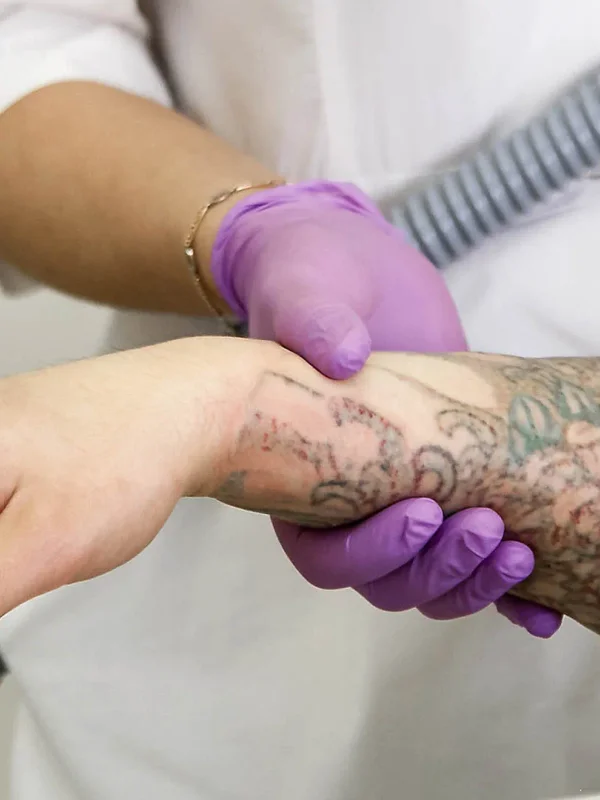
Laser Tattoo Removal
Clears or lightens ink across a range of colors.

Tattoo removal breaks ink into fragments small enough for your body to clear. Ink color, depth, and age all change how many sessions it takes.
Tattoo ink is permanent for a specific reason. The particles are deposited in the dermis, and they are too large for the immune cells that patrol that layer to pick up and carry away. Your body has been trying to clear the tattoo since the day it was placed and has not been able to. Removal does not lift ink out of the skin. It breaks the particles into fragments small enough that your immune system can finally finish the job it started, which then happens gradually over the weeks between sessions.
Three things decide how long that takes. Color comes first: black and dark blue absorb light across a broad range and clear the most predictably, while greens, light blues, reds, and especially yellows and whites absorb narrowly and can be stubborn or nearly unresponsive. Depth comes second: professional work is placed deep and densely, amateur or stick-and-poke work sits shallower and usually clears in fewer sessions. Age comes third, because a tattoo you have had for twenty years has already faded partway on its own.
This is why nobody honest quotes you one appointment. Removal is a series, spaced six to eight weeks apart so the body has time to clear what was fragmented last time, and the number of sessions is an estimate we give you at the consultation after evaluating your tattoo, your skin type, and your medical history.
Laser Tattoo Removal delivers quick pulses of light energy that the pigment absorbs and the surrounding skin largely does not. The ink shatters into smaller fragments while the skin around it is left intact. Different pigments absorb different wavelengths, so a multicoloured tattoo is treated with more than one, and part of what a consultation establishes is which of your colors we have a good wavelength for and which we do not.
Pico Laser works on the same principle with a much shorter pulse, measured in trillionths of a second rather than billionths. The effect shifts from mostly heat to mostly pressure: the ink is shattered by a rapid mechanical shockwave rather than cooked apart. That produces smaller fragments, which the immune system clears more readily, and it tends to make headway on the colors that resist conventional treatment, particularly greens and blues. Less heat in the tissue also means it is generally easier on the surrounding skin.
A session runs from a few minutes for a small tattoo to around 45 minutes for a large one. It feels like a rubber band snapped repeatedly against the skin, with cooling used throughout, and afterwards the area is pink and swollen, and that usually settles over the next few days. Blistering and crusting are normal and not a complication. The area needs ointment, gentle cleaning, and strict sun protection until it settles, and no picking at scabs or blisters.
The waiting between sessions is not padding. The rate-limiting step in removal is not the laser, it is your immune system carrying fragments away, and the skin also needs that time to heal before the next session.
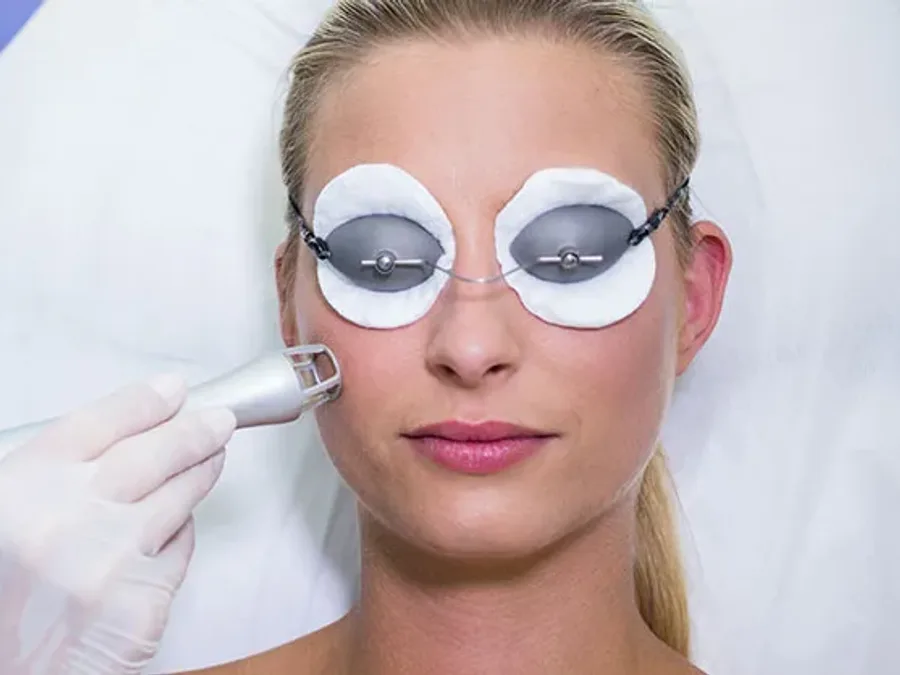
Decide the goal before you book the first session, because the two goals cost very different amounts of time. If you are removing the tattoo, you are committing to a full course. If you are lightening it so a new artist has a clean canvas, that is often a handful of sessions rather than a full course, and it is worth talking to your artist first about how faded they need it. People routinely sit through several unnecessary appointments because nobody asked them which outcome they were after.
The honest range of outcomes is wide. Older amateur black ink on fair skin is close to a best case and usually clears well. A dense, layered, multicoloured piece with greens and yellows in it is a long course, and some of that ink may never fully leave. We would rather tell you that at the consultation than after your fifth session. Faint residual shadowing where a tattoo used to be is a common end point, and for many people it is a perfectly good one.
Pico Laser is not automatically the right answer just because it is the newer technology. Where the difference genuinely shows is stubborn colors and cases where reducing the total number of sessions matters to you. Straightforward black ink responds well to either, and what matters is the wavelength and the energy chosen for your tattoo and your skin type.
Skin tone changes the calculation. Deeper skin has more pigment competing with the ink for the same light, which raises the risk of lightening or darkening the treated patch, so treatment is done more conservatively, often with a test spot first. A fresh tan is a reason to postpone. Tell us up front about your general health, any medications you take, and whether you are pregnant or nursing, because those affect whether and when we treat. What a consultation settles is which wavelengths your tattoo needs, a realistic session count, the spacing, and whether full clearance or fading is the sensible target.

Listed in the order we most often recommend them, with a line on when each is the right pick.
Your consultation decides which actually fits your anatomy, your goals, and the downtime you can spare.
Worth reading
Achieve beautiful, natural brows again with our expert eyebrow tattoo removal services. Safe, effective solutions are available near you for all tattoo types.
Read the answerWorth reading
Laser tattoo removal is tailored to your skin type, ink and goals over a series of sessions. Learn how it works and how to choose a Cincinnati clinic.
Read the answerRelated concern
Pockets that diet and exercise will not move
Start from the concernTell us what you would like to change and we will come back with the treatments that fit, honest expectations, and a time to talk it through.
Your details go straight to our Montgomery Road front desk and are never shared. A team member replies during office hours, usually the same day.

Book a consultation at our Montgomery Road office, or call and we will help you decide where to start.
Medically reviewed by Shalini Gupta, MD, Harvard-trained dermatologist and founder of The Dermatology, Laser & Vein Center. Last reviewed September 2026. This page is for education and is not a substitute for a personalized medical consultation.