
SmartGraft Hair Restoration
Moves your own follicles to restore density permanently.

Hair loss is easier to hold onto than to get back, so timing matters. Regenerative treatments can thicken hair you still have, while transplantation is what restores hair already gone.
Hair does not fall out all at once. In pattern hair loss the follicles miniaturize: each growth cycle produces a slightly finer, shorter hair than the cycle before it, until what remains is barely visible and the follicle eventually stops producing anything at all. The part widens, the hairline creeps back, and the scalp starts showing through in bright light. For a long stretch of that process, though, the follicles are still alive and still cycling.
That is the entire reason timing matters here. A follicle that is thinning can often be pushed back toward normal function. A follicle that has been gone for years is unlikely to respond, because once a follicle has shut down completely there is very little left to stimulate. Holding onto hair you still have is a far easier problem than replacing hair you have already lost, and the treatments divide along exactly that line: regenerative treatment for what is thinning, transplantation for what is gone.
Before any of it, the cause matters. Pattern loss is the most common kind but it is not the only kind. Thyroid disease, iron deficiency, recent illness, childbirth, and autoimmune conditions all cause hair to fall, and some of those causes produce temporary shedding rather than permanent loss, which is why identifying the cause comes first. A scalp exam and a review of your health history come before any decision about treatment, because treating the wrong problem here is both expensive and slow.
Two of the three options work by signaling. Plasma Protein for Hair Restoration starts with your own blood: a sample is drawn, spun down to concentrate the platelets and the growth factors they carry, then injected across the thinning areas of the scalp. Those growth factors are the same ones your body uses for repair everywhere else, and the aim is to prolong the growth phase in follicles that have begun cutting it short. It is done as an initial series spaced a few weeks apart and then maintained periodically, and because the material is your own blood, the risk of an allergic reaction is low. Platelet rich plasma for hair restoration is not an FDA approved use, and we will go over that with you before you decide.
Exosomes for Hair Restoration works further upstream on the same idea. Exosomes carry growth factors, cytokines, and signaling molecules to dormant or weakened follicles, so the preparation is a concentrated dose of that messaging rather than a concentrate of your own platelets. No blood draw is involved, and it is aimed at follicles that are weakened or dormant rather than gone, where there is still something to signal. Depending on your condition, follow-up sessions may be recommended, and your provider maps that plan out at consultation. There are no FDA approved exosome products, so exosome therapy for hair is offered as an elective treatment and we will discuss that status with you as well.
SmartGraft Hair Restoration is a different category altogether. It is follicular unit extraction: individual follicles are harvested one at a time from the back and sides of the scalp, where hair is genetically resistant to the hormone that drives pattern loss, held in a controlled environment, and placed into the thinning or bare areas. The relocated follicles keep that original resistance, which is why the density they create is permanent. No strip of scalp is removed and no linear scar is left behind, which is the main practical advantage over older transplant techniques.
What that last one costs is time and scale. A transplant is a procedure day rather than an appointment, the transplanted hairs shed within a few weeks before they regrow, visible growth begins a few months in, and the full result takes roughly a year to show itself. It is also the only option here that can put hair where there is currently none.
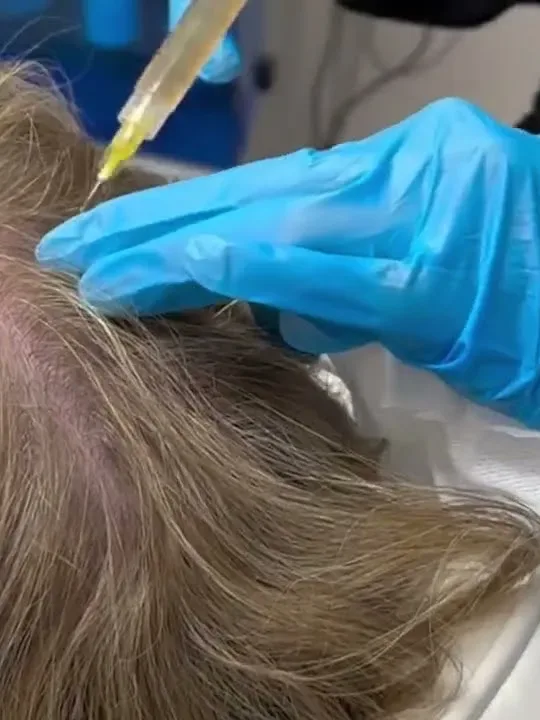
If your part has widened and your ponytail is thinner but there is still hair across the area, you are inside the window where Plasma Protein for Hair Restoration and Exosomes for Hair Restoration make sense. This is also the point at which most people wait, hoping it settles on its own, and results depend a great deal on how early you begin treatment. Every year of continued miniaturization moves more follicles from the treatable column into the permanent one.
If the scalp is genuinely bare, be honest with yourself about it. Once an area has been bare for several years, injections alone are unlikely to bring it back. SmartGraft Hair Restoration is what restores density in that situation, and it does it well, but it draws on a finite donor supply at the back of your head. That supply has to be budgeted across a lifetime of loss rather than spent all at once on a front hairline at thirty.
Combining the two is often the right answer, and the reason is worth understanding. Transplanting into an area where the surrounding native hair is still actively thinning can look uneven over time, because the grafted hair stays put while everything around it continues to thin. Slowing the ongoing loss, with regenerative treatment, medical therapy, or both, is what keeps a transplant looking natural over the long run.
A consultation for hair is mostly diagnosis. We look at the pattern, at the quality of the donor area, at how quickly the loss has progressed, and at whether anything medical is contributing to it. It is also where expectations get set, because there is a real difference between restoring density and restoring the hairline you had at twenty, and that is far better to hear in the room than to discover a year later.

Listed in the order we most often recommend them, with a line on when each is the right pick.
Your consultation decides which actually fits your anatomy, your goals, and the downtime you can spare.
Worth reading
Tired of topical hair loss treatments that don’t deliver? Learn how SmartGraft offers permanent hair restoration for lasting results.
Read the answerWorth reading
Want a lower, more youthful hairline? Discover how SmartGraft can reshape and restore your hairline without surgery, scars, or downtime.
Read the answerWorth reading
Wondering when your new hair will grow after SmartGraft? Learn the full hair growth timeline and what to expect from your procedure.
Read the answerTell us how long you have noticed thinning and what you have tried. We will come back with realistic options, from in-office treatments to SmartGraft.
Your details go straight to our Montgomery Road front desk and are never shared. A team member replies during office hours, usually the same day.

Book a consultation at our Montgomery Road office, or call and we will help you decide where to start.
Medically reviewed by Shalini Gupta, MD, Harvard-trained dermatologist and founder of The Dermatology, Laser & Vein Center. Last reviewed September 2026. This page is for education and is not a substitute for a personalized medical consultation.