
Tummy Tuck
A tummy tuck removes the loose skin and repairs the separated abdominal muscles that diet and exercise cannot reach, which is why it is the answer after pregnancy or significant weight loss rather than liposuction alone.
What is atummy tuck?
A tummy tuck, or abdominoplasty, removes the stretched skin across the front of the abdomen and repairs the muscle wall underneath it. It exists for two problems that diet and exercise cannot reach: skin that has been stretched past the point where it will retract on its own, and the rectus abdominis muscles that separate down the midline during pregnancy, a condition called diastasis recti.
That is the honest line between this operation and everything else offered for the midsection. Liposuction removes fat. It does not tighten loose skin and it cannot bring separated muscles back together. If your skin still has good elasticity and your concern is a localized pocket of fat, liposuction or a non-surgical body contouring treatment is the better and far less invasive answer. But if the skin hangs, or the abdominal wall still bulges no matter how much core work you do, no amount of training and no external device will close that gap. Stitching the separated muscles back together during surgery, called plication, is the only permanent repair.
It is also worth saying plainly that a tummy tuck is not a weight loss procedure. Some fat comes out with the skin, but the scale may move very little. What changes is the contour and the way clothing fits. Surgery is performed by Dr. Balvant Arora, a board-certified plastic, reconstructive and cosmetic surgeon, in our accredited in-house surgical suite in Cincinnati.
Who is tummy tuck for?
Tummy Tuck is surgery, so candidacy is decided in person.
Dr. Arora assesses your anatomy, your health, and what the operation can and cannot achieve in your case, including risks and recovery, before anything is scheduled.
Loose abdominal skin
Your skin has not tightened with weight loss or exercise and no longer retracts on its own.
Separated muscles
Your abdominal muscles separated during pregnancy and your midsection still bulges despite core training.
Stable weight
You are at or near a stable goal weight, since this operation contours rather than replaces weight loss.
Done having children
You have finished childbearing, because a later pregnancy stretches the muscle repair again.
Good general health
You are in good health and a non-smoker, or willing to stop before and after surgery.
Accepts the scar
You accept that a permanent low abdominal scar is part of the result.
Where a tummy tuckworks
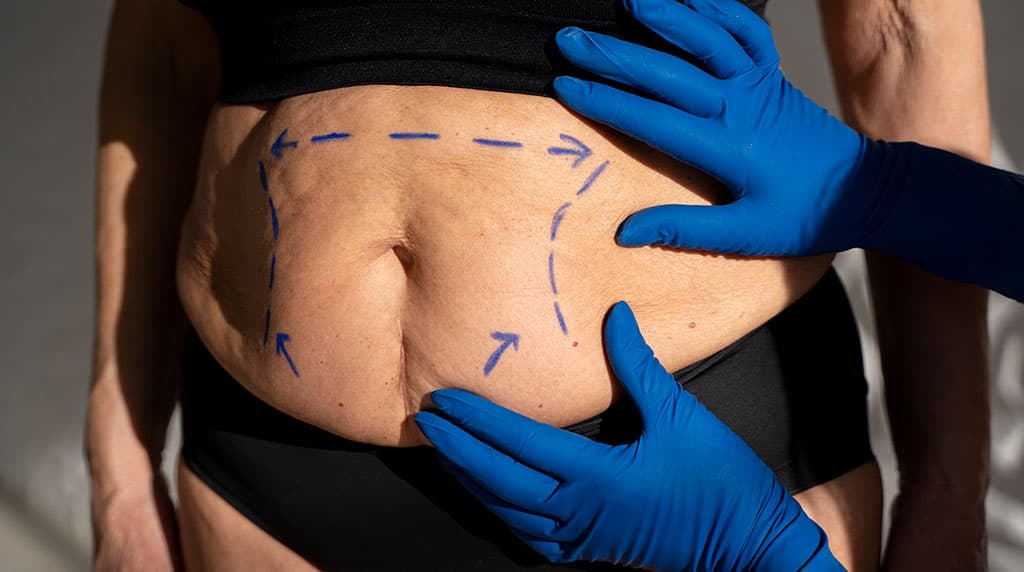
A tummy tuck works on the front of the abdominal wall. It treats two layers at once: the stretched skin on the surface and the muscles underneath that separated during pregnancy.
Where liposuction is added in the same operation, the flanks are contoured so the waistline follows the new abdominal shape.
How the procedure is performed
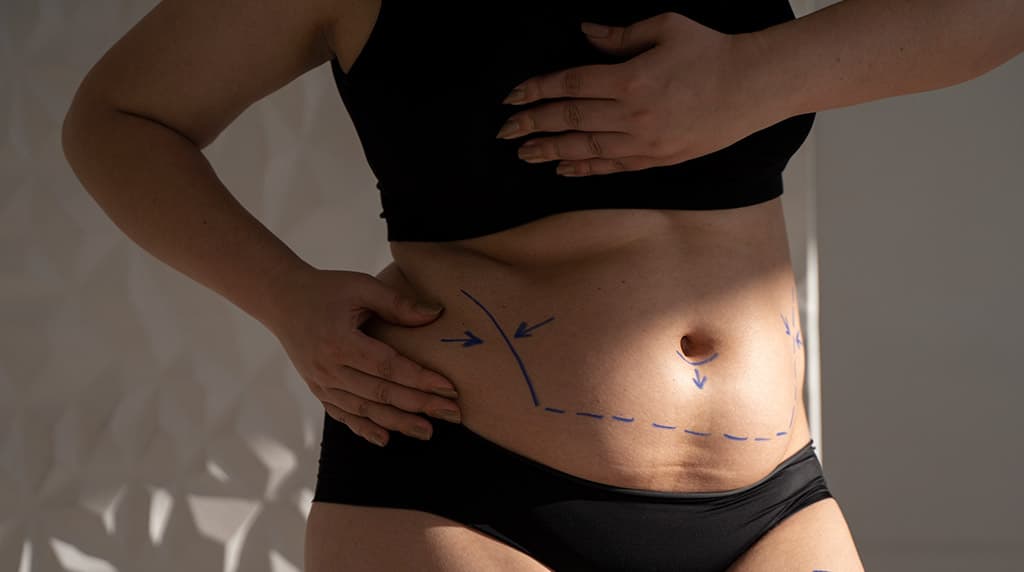
Abdominoplasty is usually an outpatient procedure performed under general anesthesia, and most patients go home the same day. Dr. Arora makes a horizontal incision low on the abdomen, positioned to sit below the line of underwear or swimwear, lifts the skin, brings the separated abdominal muscles back together with internal sutures, removes the excess skin and fat, and closes with the remaining skin drawn taut. The navel is repositioned when the amount of skin removed requires it. Most procedures take about two to four hours depending on how much correction is needed and whether liposuction is performed at the same time. Stretch marks that sit on the skin being removed, generally the skin below the navel, come off with it. Marks above the navel stay.
Not everyone needs the same operation. Dr. Arora recommends an approach at consultation based on your anatomy, not from a menu.
Full tummy tuck. Addresses the entire abdomen, and suits significant skin laxity with muscle separation.
Mini tummy tuck. Treats only the area below the navel, and suits a smaller amount of loose skin.
Extended tummy tuck. Reaches around to the flanks and hips.
Fleur-de-lis. Adds a vertical incision when skin has to be removed in both directions, which is usually a question after major weight loss.
Recovery and what results look like over time
Recovery from a tummy tuck is measured in weeks rather than days, and the timeline below is the one to plan around.
Expect genuine soreness and tightness in the first week, managed with prescribed medication and a compression garment. Swelling and bruising are normal.
Plan on roughly ten days to two weeks before returning to non-strenuous work, and longer if your job involves lifting or physical labor. Some patients feel ready sooner, but two weeks is the realistic figure to plan around. Normal exercise generally resumes at about six to eight weeks, once Dr. Arora clears you.
The change in contour is visible immediately, but it is not the final result. Swelling takes several months to settle fully, and the scar follows its own timeline: firm and colored at first, then flattening and lightening over the following year. The scar is permanent. It is placed where clothing covers it, and most patients consider it a fair trade for removing the skin, but it belongs in the decision rather than arriving as a surprise.
Results are durable. The skin and fat removed are gone for good and the muscle repair holds, so results are long-lasting when your weight stays stable. Two things undo it: a later pregnancy, which stretches the repair again, and significant weight gain. That is why finishing childbearing first is the usual advice, and why a stable weight matters more here than a low one.
Whatto expect.
Book a consultationThere is no set price. What the operation involves varies with how much correction is needed and whether liposuction is performed at the same time, so you receive a figure after Dr. Arora examines you.
Most procedures take about two to four hours, depending on how much correction is needed and whether liposuction is included. It is usually an outpatient operation under general anesthesia, so you go home the same day.
Plan on roughly ten days to two weeks before returning to non-strenuous work, and longer if your job involves lifting or physical labor. Normal exercise generally resumes at about six to eight weeks, once Dr. Arora clears you.
The contour changes immediately, though swelling takes several months to settle and the scar keeps flattening and lightening over the following year. With a stable weight and a consistent routine, the result is long-lasting.
Frequently asked questions
How is a tummy tuck different from liposuction?
Liposuction removes fat through small incisions and does nothing to skin or muscle. A tummy tuck removes stretched skin and repairs separated abdominal muscles, and often includes liposuction for contouring in the same operation. If your skin tone is good and fat is your only concern, liposuction is the less invasive choice. If the skin is loose or the abdominal wall is separated, surgery is what corrects it.
How long is the recovery?
Most patients take about ten days to two weeks off work, and longer for physically demanding jobs. Light activity returns within the first two to three weeks, and full exercise at roughly six to eight weeks once you are cleared. Swelling continues to settle for several months beyond that.
Will I have a scar?
Yes, and it is permanent. The incision runs low across the abdomen, positioned to sit below underwear and swimwear. It fades and flattens considerably over the first year, and scar treatments can help it along, but nothing removes it entirely.
What kind of anesthesia is used?
A tummy tuck is generally performed under general anesthesia as an outpatient procedure, so you go home the same day with someone to drive you and stay with you. Your medical history and any anesthetic concerns are reviewed with you beforehand.
How long do the results last?
With a stable weight and a healthy routine, results are long-lasting, since the removed skin and fat do not come back and the muscle repair holds. Future pregnancy and significant weight gain are what typically reverse them. Natural aging still affects skin elasticity over time, though the tightened muscle generally stays intact.
Can it be combined with other procedures?
Yes. Liposuction is frequently done at the same time, and many patients combine a tummy tuck with breast surgery as a mommy makeover so there is one anesthetic and one recovery. Whether combining is appropriate depends on your health and the total length of the operation, and Dr. Arora will say so if staging is the safer plan.
Where to next
Related procedure
Breast Augmentation
Restore or enhance volume with silicone or saline implants.
Explore the procedureRelated treatment
Liposuction
Remove stubborn fat for good.
Explore the treatmentWorth reading
From Week One to Wow: What to Expect After VASER Liposuction
When it comes to body contouring, one of the biggest misconceptions is that results happen instantly. The truth is, while advanced treatments like VASER
Read the answerAsk about body contouring.
Tell us the area you have in mind and what you have tried. We will come back with which treatments make sense, what they cost, and when you could start.
Your details go straight to our Montgomery Road front desk and are never shared. A team member replies during office hours, usually the same day.

Ready when you are.
Book a consultation at our Montgomery Road office, or call and we will help you decide where to start.
Surgical procedures reviewed by Dr. Balvant Arora, MD, MBA, board-certified plastic surgeon at The Dermatology, Laser & Vein Center. Last reviewed September 2026. This page is for education and is not a substitute for a surgical consultation. Every operation carries risk, and candidacy is determined in person.