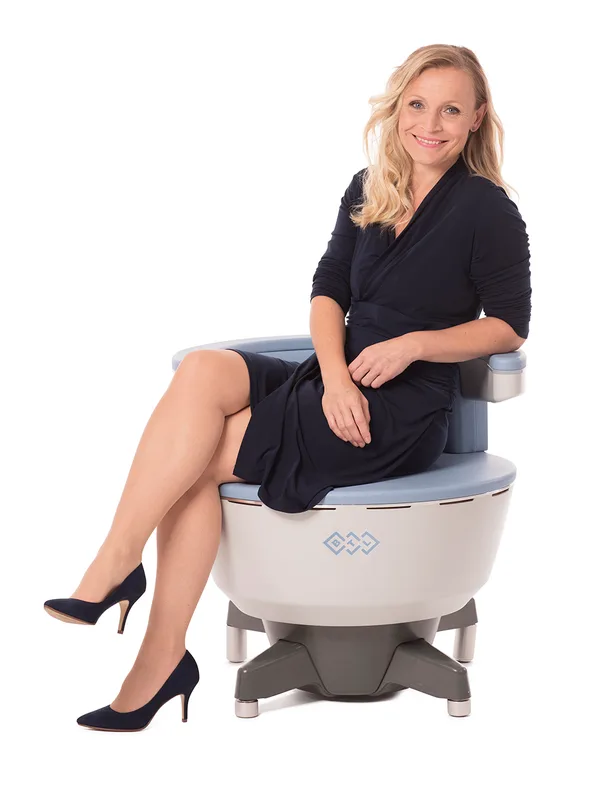
EMSELLA
Thousands of pelvic floor contractions per session, fully clothed.

Stress incontinence comes from a weakened pelvic floor, and it is far more common than most people realize. These treatments strengthen and support that floor without surgery, and the EMSELLA chair is done fully clothed.
Leaking when you laugh, cough, sneeze, or exercise is called stress incontinence. The pelvic floor is a group of muscles that support the bladder, and when those muscles stretch or weaken they lose the strength and function needed to keep the urethra closed. The usual causes are pregnancy and childbirth, the fall in estrogen at menopause, and aging tissue. It is extremely common and almost nobody mentions it, which leaves most people with it convinced they are unusual.
There is a second kind. Urge incontinence is the sudden, intense urge to urinate, and the difficulty of controlling urination once that urge arrives. These treatments are used for stress, urge, and mixed urinary incontinence, and stress incontinence is where the case for them is strongest. Many people have some of both, and sorting out which is dominant changes the plan.
If you are experiencing incontinence alongside other troubling symptoms, you should see a medical professional first, because there could be something going on of a more serious nature. For severe cases these treatments are not a replacement for medical treatment, and we will tell you if that is where you are rather than start a course that cannot get you there.
EMSELLA is a chair, and you sit on it fully clothed. A focused electromagnetic field passes through the seat and causes the entire pelvic floor to contract far harder and far more times than you could ever manage voluntarily, thousands of contractions in a session that runs about half an hour. Nothing is inserted, nothing is removed, and you can read or scroll throughout. It feels like a strong tingling and a deep muscular tightening, occasionally odd but not painful. A typical course is six sessions spread over a few weeks, and you drive yourself home afterwards with no recovery at all.
ThermiVa works on the tissue rather than the muscle. A small handpiece delivers gentle radiofrequency warmth internally and externally, raising the tissue to a controlled temperature that stimulates collagen and improves blood supply. Better quality, better supported tissue around the urethra improves mild stress leaking. It needs no anesthesia, feels like a warm massage, takes about 30 minutes, and is usually done as a short series of treatments spaced about a month apart with no downtime.
Plasma Protein for Incontinence uses your own blood. A sample is drawn and spun to concentrate the platelets and the growth factors they carry, and that concentrate is injected, with numbing, into the tissue supporting the urethra to prompt local regeneration and new blood supply. It is aimed at the cases where the limiting factor is the quality of thinned, poorly vascularized tissue rather than the strength of the muscle, which is a common picture after menopause. Plasma protein therapy is an autologous treatment that is not specifically FDA-approved for incontinence and is used off-label.
Read as a group, the three treat different layers of the same problem. EMSELLA trains muscle. ThermiVa improves the structural quality of the tissue. Plasma Protein for Incontinence tries to regenerate that tissue where it has genuinely thinned. They are frequently combined, most often EMSELLA for the muscle alongside one of the other two for the tissue.

For most stress incontinence, and particularly after childbirth, we would start with EMSELLA. You stay dressed, there are no needles, there is no recovery, and within a course you find out clearly whether your pelvic floor responds to training. That answer is useful regardless of what comes next. It is also, frankly, the easiest thing to say yes to when you have spent years not raising the subject at all.
It is worth saying that properly taught pelvic floor physical therapy is genuinely effective and is not competing with any of this. These treatments work best alongside a floor you are also using correctly, not instead of one. Many people who do Kegels every day still find their workouts are not as productive as they could be, which is why technique is worth checking.
Be clear about the limits. EMSELLA is used as a supportive treatment for pelvic organ prolapse rather than a repair for it. If you are leaking heavily rather than in occasional small amounts, these are not a replacement for medical treatment, and hearing that early is better than paying to find it out slowly.
Results are also not permanent, because the causes continue. Muscle detrains, estrogen keeps falling, and time passes, so most people return for occasional maintenance sessions to hold what they gained. A consultation establishes whether your leaking is stress, urge, or mixed, how severe it actually is, and which combination is worth your time.

Listed in the order we most often recommend them, with a line on when each is the right pick.
Your consultation decides which actually fits your anatomy, your goals, and the downtime you can spare.
Worth reading
Learn how EMSELLA at The Dermatology, Laser & Vein Center in Cincinnati, Ohio can treat postpartum pelvic floor weakness and urinary incontinence.
Read the answerWorth reading
For women seeking non-invasive solutions to enhance sexual function ThermiVa offers a revolutionary, non-surgical option. Improve your life today!
Read the answerRelated concern
Dryness, laxity, and comfort
Start from the concernTell us the area you have in mind and what you have tried. We will come back with which treatments make sense, what they cost, and when you could start.
Your details go straight to our Montgomery Road front desk and are never shared. A team member replies during office hours, usually the same day.

Book a consultation at our Montgomery Road office, or call and we will help you decide where to start.
Medically reviewed by Shalini Gupta, MD, Harvard-trained dermatologist and founder of The Dermatology, Laser & Vein Center. Last reviewed September 2026. This page is for education and is not a substitute for a personalized medical consultation.