
Facelift
A facelift repositions the deeper tissue of the face and neck and removes the skin left over, which is what separates it from every device that tightens skin from the outside.
What isa facelift?
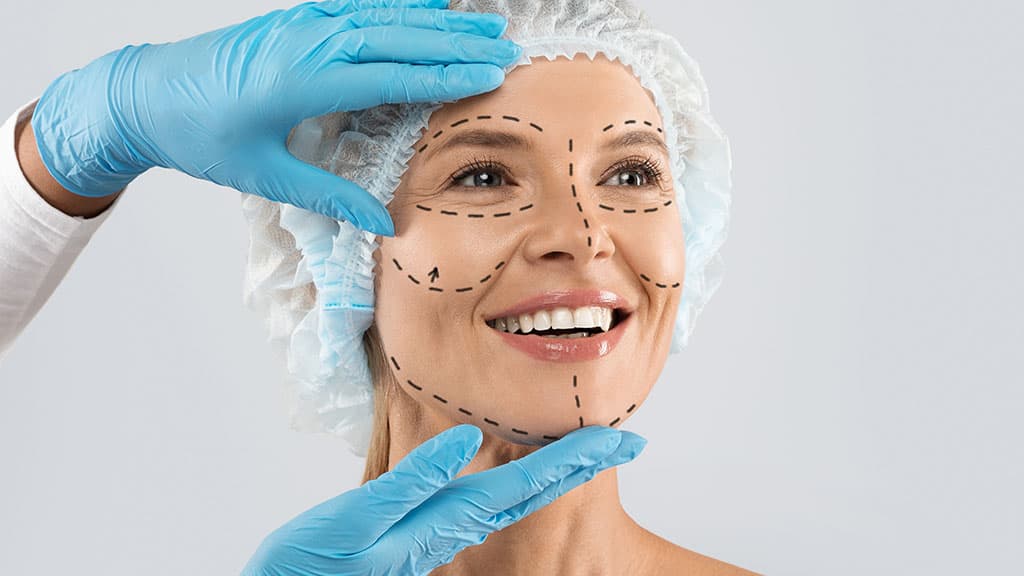
A facelift, or rhytidectomy, treats sagging in the mid-face, the jawline and the neck by repositioning the tissue beneath the skin and then removing the skin that is left over. The layer that does the lifting is the SMAS, the sheet of connective tissue that sits between the skin and the facial muscles. Once that layer is lifted, the skin is re-draped over the new contour rather than pulled tight across it, which is what keeps normal movement and expression intact.
That is a categorically different thing from tightening skin from the outside. Energy devices heat tissue to prompt new collagen, and injectables replace lost volume or soften lines. Both are useful, and this practice offers a great deal of both, but neither removes skin and neither achieves the same level of lifting or the same durability as surgery. When there is real excess skin, when the jawline has lost its line, or when the neck has gone slack, non-surgical treatment delays the point at which surgery becomes the answer. It does not stand in for it.
Facelift surgery at The Dermatology, Laser & Vein Center is performed by Dr. Balvant Arora, a board-certified plastic, reconstructive and cosmetic surgeon with decades of experience in facial surgery, in the practice's accredited on-site surgical facility in Cincinnati, Ohio. Because the practice also runs a full non-surgical program, a consultation can end with either recommendation, and often ends with a plan that uses both at different stages.
Who is facelift for?
Facelift is surgery, so candidacy is decided in person.
Dr. Arora assesses your anatomy, your health, and what the operation can and cannot achieve in your case, including risks and recovery, before anything is scheduled.
Sagging past what devices reach
Sagging in the mid-face, jowls along the jawline, or loose neck skin that injectables and energy treatments no longer improve.
Typically forties to seventies
Most patients are somewhere between their forties and seventies, though skin elasticity, bone structure, and general health matter more than age.
Cleared for surgery
In good general health and cleared for surgery, with no upper age limit as long as that holds.
A non-smoker
Not smoking, or willing to stop well before surgery, since smoking affects healing and shortens how long the result lasts.
Two weeks to recover
Able to set aside about two weeks before returning to non-strenuous work, and to accept that the face keeps settling for months after that.
Sagging, not surface
Not the right operation if the main complaint is skin texture, pigment or fine lines rather than sagging, since skin tone and texture are addressed with laser resurfacing or peels planned alongside the surgery.
Where a faceliftworks
A facelift works on the mid-face, the jawline and the neck. The lift happens in the SMAS, the sheet of connective tissue between the skin and the facial muscles, which is why the correction holds instead of relapsing the way a skin-only pull does.
It does not treat the upper face. Forehead lines, brow position and the eyelids are separate problems with separate answers, from a brow lift or eyelid surgery to non-surgical treatment, and they are planned alongside a facelift rather than covered by it.
Where the lift actually happens
The distinction that matters most in facelift surgery is depth. A lift that pulls only on the skin can look good at first, but skin is elastic and the correction tends to relapse. Lifting the deeper layer instead puts the tension where the tissue can hold it, which is what produces a result that both looks natural and lasts. This is why the operation is described in terms of the layer it works in rather than in terms of how much skin comes off.
SMAS facelift. Tightens the connective tissue layer and re-drapes the skin over it, improving the cheeks, the jawline and the neck together. The practice cites a typical range of roughly ten to twelve years.
Deep plane facelift. Releases and lifts the SMAS and the tissue beneath it as a single unit, which puts less tension on the skin. Typical range of ten to fifteen years or longer.
Mini facelift. Smaller incisions, concentrating on the lower face and jawline, with a shorter recovery and a shorter life to the result, in the range of five to seven years. It suits earlier and milder sagging.

Where non-surgical treatment stops and surgery starts
Devices and injectables buy time and maintain a result, while surgery changes the structure. Many patients spend years on non-surgical treatment and move to surgery when it stops delivering what it used to, which is a reasonable sequence rather than a failure of either one. The same treatments are also used after a facelift, to work on skin tone, texture and pigment, which surgery does not address.
Ultherapy, which this practice has offered for years, uses focused ultrasound to heat tissue below the surface and prompt the body to build new collagen and elastin. Most patients have one or two treatments, there is no required downtime, results build over three to six months as the collagen forms, and maintenance sessions every couple of years keep the effect going. It is a real treatment with a real effect on mild to moderate laxity around the cheeks, jawline, brow and neck.
What Ultherapy does not do is remove skin, and it cannot achieve the same level of lifting or the same durability as surgery. Thread lifts have the same ceiling: dissolvable sutures lift sagging skin temporarily, with results generally lasting one to two years. Fillers restore volume that has been lost, which can improve how a face reads, while a lift repositions sagging tissue, so the two address different problems. Once the laxity is past mild to moderate, the practice will usually recommend combining treatments or looking at surgery rather than repeating the same one.

Recovery and how long the result lasts
Facelift results typically last in the range of ten to fifteen years, with the deeper techniques at the longer end of that.
Swelling and bruising are expected, and they subside gradually over the weeks that follow. Most patients return to light, non-strenuous activity and non-strenuous work within ten to fourteen days. With the deeper techniques, most of the swelling and bruising takes two to three weeks to resolve, and the face continues to settle over the following months, so the final result is not the one you see at the two-week mark. Discomfort is generally described as tightness or pressure more than pain, and is managed with prescribed medication.
Incisions are placed along natural creases and within the hairline so they are as concealed as the anatomy allows, and they fade over time. Dr. Arora provides post-operative instructions and follow-up visits through the healing period, and the practice offers LED therapy and scar management to support recovery. As with any operation, the risks and the specifics of your own healing are covered at the consultation rather than on a web page.
Aging does not stop, so the face keeps changing, and how long the result holds depends on skin quality, sun exposure, smoking and general health as much as on the surgery itself. Sun protection, consistent skin care and periodic non-surgical treatment are what preserve it. Some patients choose a second procedure after ten to fifteen years, and many do not.
Whatto expect.
Book a consultationA facelift is quoted after Dr. Arora examines your anatomy, because a mini lift, a SMAS lift and a deep plane lift are different operations. A neck lift planned alongside changes the quote as well.
How long surgery takes depends on whether a mini, SMAS or deep plane lift is planned and whether the neck is treated at the same time. It is performed under local anesthesia with sedation or under general anesthesia in the practice's accredited on-site surgical facility.
Most patients return to light, non-strenuous activity and non-strenuous work within ten to fourteen days. With the deeper techniques, most of the swelling and bruising takes two to three weeks to resolve, and the face keeps settling for months after that.
Results typically last in the range of ten to fifteen years, with the deeper techniques at the longer end and a mini facelift closer to five to seven years. Sun protection, consistent skin care and periodic non-surgical treatment are what preserve them.
Frequently asked questions
How long do facelift results last?
The practice cites a typical range of ten to fifteen years, with deep plane and SMAS techniques at the longer end and a mini facelift closer to five to seven years. Aging continues afterward, so the face keeps changing. Skin quality, sun exposure, smoking and general health all affect how long the result holds.
What kind of anesthesia is used?
Facelifts are performed under local anesthesia with sedation or under general anesthesia, depending on how extensive the procedure is. Surgery takes place in the practice's accredited on-site surgical facility. Dr. Arora will recommend the approach that is safest and most comfortable for your particular case.
How long is the recovery?
Most patients return to light, non-strenuous activity and work within ten to fourteen days. With the deeper techniques, most of the swelling and bruising resolves over two to three weeks, and full healing continues for several months. Discomfort is usually described as tightness or pressure rather than pain and is managed with prescribed medication.
Will the scars show?
Incisions are placed along natural creases and within the hairline, which is what keeps them concealed, and they fade over time. Any operation leaves scars, and how yours heal depends in part on your skin. Scar management is part of the follow-up care the practice provides.
Can a facelift be combined with other procedures?
Yes. A neck lift is the most common addition when the neck is also lax. Eyelid surgery, a brow lift, fat grafting to restore volume in the cheeks and temples, and laser resurfacing for skin tone and texture are all planned alongside a facelift when they are warranted.
Can non-surgical treatment replace a facelift?
No. Treatments such as Ultherapy, radiofrequency, lasers and fillers work on mild to moderate laxity and on skin quality, and they can delay the point at which surgery is worth considering or help extend a surgical result. They do not remove skin, so they cannot produce the same lift or the same durability as surgery.
Where to next
Related procedure
Tummy Tuck
Remove excess skin and repair separated muscles.
Explore the procedureRelated treatment
Ultherapy
Ultrasound lift for face, neck, and brow.
Explore the treatmentWorth reading
Ultherapy and Fillers: The Perfect Combination for Lifting, Smoothing, and Restoring Youthful Volume
When it comes to facial rejuvenation, one treatment alone is not always enough to address every concern. Aging affects the skin in multiple ways, including
Read the answerAsk about body contouring.
Tell us the area you have in mind and what you have tried. We will come back with which treatments make sense, what they cost, and when you could start.
Your details go straight to our Montgomery Road front desk and are never shared. A team member replies during office hours, usually the same day.

Ready when you are.
Book a consultation at our Montgomery Road office, or call and we will help you decide where to start.
Surgical procedures reviewed by Dr. Balvant Arora, MD, MBA, board-certified plastic surgeon at The Dermatology, Laser & Vein Center. Last reviewed September 2026. This page is for education and is not a substitute for a surgical consultation. Every operation carries risk, and candidacy is determined in person.