Lauren Barnhill, MSN, RN, FNP-C
Family nurse practitioner
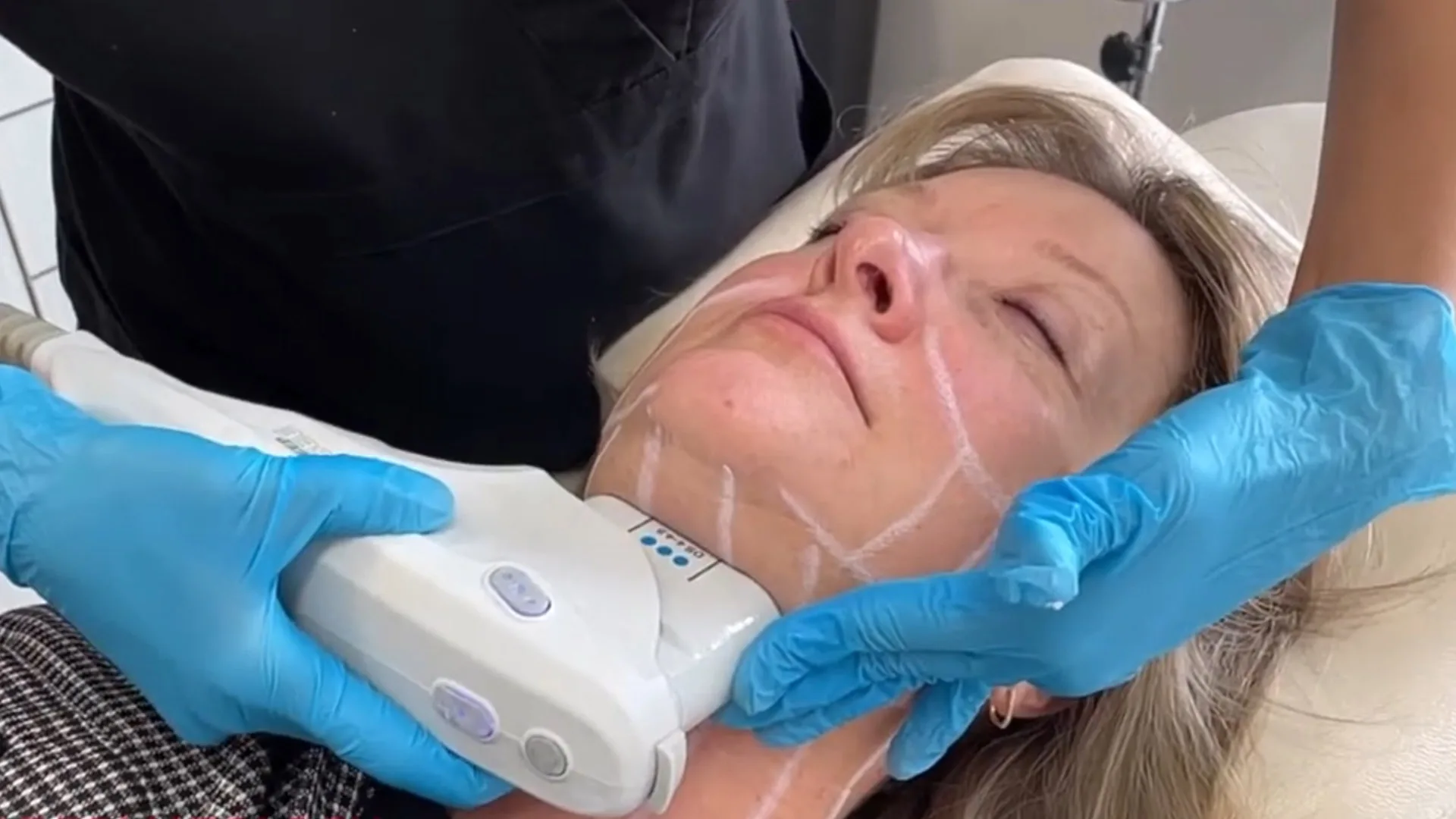
Both tighten skin without surgery by heating collagen so your skin builds more of its own. Ultherapy focuses ultrasound on the deep lifting layer under the brow, jaw and neck. Thermage spreads radiofrequency heat across a broader area of skin, including the eyelids.
Both are FDA-cleared, and both rely on the same idea: controlled heat below the surface prompts your skin to build new collagen, so firmness returns gradually over the following months. Neither breaks the skin, and neither needs anesthesia. The difference is the kind of energy, and so where the heat ends up.
Ultherapy uses focused ultrasound. The energy passes through the surface without affecting it and concentrates at points deep beneath it: in the foundation layer a surgeon would tighten in a facelift, and in the deep dermis above. Because it works at that depth, its strength is lift. It raises a brow that has started to drop and firms the line of the jaw and neck, rather than changing the feel of the skin across the whole face. See the Ultherapy treatment page for the full visit.
Thermage uses monopolar radiofrequency. The handpiece heats the deeper layers of the skin evenly across the treated area while a cooling spray protects the surface. The heat makes existing collagen contract, which some patients notice as subtle tightening right away, then signals the skin to remodel. Because the heat is spread across the skin rather than focused at a point, it suits broad firming, and it can be used on delicate areas such as the eyelids. See the Thermage treatment page for the full visit.
You may also hear about EMFACE, which works on a different layer again: it tones the facial muscles underneath, alongside radiofrequency for the skin, rather than tightening by heat alone.
The same questions, answered for each device. Everyone responds differently, so treat these as typical patterns rather than promises. For how long results tend to hold, see how long Ultherapy lasts and how long Thermage lasts.
| Question | Ultherapy | Thermage |
|---|---|---|
| Energy | High intensity focused ultrasound, delivered in precise pulses through a handpiece over ultrasound gel. | Monopolar radiofrequency, delivered as heat with a cooling spray that protects the surface between pulses. |
| Depth | Passes through the surface to the deep foundation layer a surgeon tightens in a facelift, and the deep dermis above it. | The deeper, collagen-rich layers of the skin itself, heated evenly across the whole treated area. |
| Best areas | Brow, cheeks and early jowls, jawline and under the chin, neck, and lines on the decolletage. | Face and cheeks, jawline, neck, decolletage, plus the abdomen, arms and thighs. |
| Eyelids | Lifts a heavy or drooping brow to open the eye area. | Yes. It firms loose skin on the lids and the fine crepiness around the eyes, without surgery. |
| What it feels like | Warmth and tingling as each pulse lands; some spots are more sensitive. Numbing cream can be applied first. | A short burst of heat with each pulse, then a cooling spray. No anesthesia is needed. |
| Session and number of treatments | One visit of 30 to 90 minutes. Most patients need just one; some repeat after a few months. | One visit of 45 to 90 minutes. Many patients need just one, with maintenance down the road. |
| Downtime | Back to work and exercise the same day. The jawline may stay sore when pressed for a few weeks. | Little to none. Mild redness or swelling, when it happens, resolves within a few hours. |
| When changes appear | Gradually, as new collagen forms: visible by two to three months, continuing up to six. | Some subtle tightening right after treatment, then firming that builds over two to six months. |
Neither device is better overall. Each is the better tool for some areas and some kinds of laxity, and the answer usually comes from where you notice the change first. These are the common situations.
A brow that has dropped, or early jowls. This is lifting work, and it points toward Ultherapy. Its energy reaches the deep layer that lets the brow and lower face slide downward, so the change reads as lift rather than only firmer skin.
Crepey or hooded eyelid skin. Thermage works on the lid skin itself. Ultherapy works from above, raising a drooping brow, which helps when the heaviness starts there.
Overall skin quality across the face. When the concern is skin that has softened everywhere rather than one area that has fallen, Thermage tends to suit, because it heats a broad area of skin evenly and tightens existing collagen on the day.
The neck and under the chin. Both firm a loosening neck. The neck is Ultherapy's signature area, and it also lifts the area under the chin. Your provider decides whether your neck needs that lift (Ultherapy) or firming as part of a wider face and neck plan (Thermage).
The abdomen, arms or thighs. Thermage. Ultherapy is cleared for the face, neck and chest; Thermage also treats mild laxity on the body, for example after weight loss or pregnancy.
More than one of the above. Because the two work at different depths, some plans use each where it fits best, such as Ultherapy for the brow and jaw and Thermage for the eyelids.
Ultherapy and Thermage are made for mild to moderate laxity. Neither replaces a facelift, and skin that has loosened significantly responds better to surgery. If that is what your consultation finds, we will say so rather than sell you a device that cannot deliver what you are hoping for.
Between the two sits FaceTite, a minimally invasive option that works beneath the surface through a tiny entry point, removing small pockets of fat along the jaw and neck while tightening the skin above them. For heavier sagging, a surgical facelift repositions the deeper tissues directly, and loose eyelid skin that Thermage cannot firm enough may be a case for eyelid surgery.
You can request your skin tightening consultation with one of our nurse practitioners, Lauren Barnhill, MSN, RN, FNP-C, or Sarah Lockwood, MSN, RN, AGACNP-BC, by choosing your preferred provider when you book.
They work within the practice Dr. Shalini Gupta, MD founded in Cincinnati in 2001, a practice that was among the first in the country to offer Ultherapy.
Patients describe them differently rather than ranking one as worse. Ultherapy is the one where numbing cream may be applied first, since some spots are more sensitive. Thermage relies on its cooling spray between pulses instead of anesthesia.
Yes, for some patients, since the two heat different layers. Your provider decides whether combining them makes sense for you and how to space the visits.
One session of either is the usual plan. A second Ultherapy treatment a few months later is optional, for more tightening, and Thermage patients may come back later for a maintenance session.
No time off is needed for either: you can return to work the same day. Expect a sore jawline for a few weeks after Ultherapy; after Thermage, any redness or swelling has usually settled within hours.
Not necessarily. Both are used as preventive treatments to keep collagen production active before laxity advances, as well as to treat early sagging. A consultation tells you whether your skin would benefit now or whether it makes sense to wait.
Yes, with Thermage, which is known for treating the eyelids. Your provider reviews your health history first, Thermage is not advised during pregnancy, and you will be told plainly if your eyelids would be better served by eyelid surgery.
If you already know which device interests you, the Ultherapy page and the Thermage page cover each visit in detail. To see real results, browse the Ultherapy before and after gallery and the Thermage before and after gallery. If the eye area is your main concern, our article on Thermage for aging, sagging eyes is a good next read.
If you are still deciding, that is what a consultation is for. Tell us where you first noticed the change, and we will recommend one, the other, both, or something else entirely.
Results vary from person to person. Nothing on this page is a guarantee of your own outcome, and candidacy and treatment planning are decided by a licensed provider at consultation.
Tell us what you would like to change and we will come back with the treatments that fit, honest expectations, and a time to talk it through.
Your details go straight to our Montgomery Road front desk and are never shared. A team member replies during office hours, usually the same day.
Book a consultation at our Montgomery Road office, or call and we will help you decide where to start.
By The Dermatology, Laser & Vein Center. This page is for education and is not a substitute for a personalized medical consultation.
